Locally Rooted, Globally Connected: Lessons from Ukraine
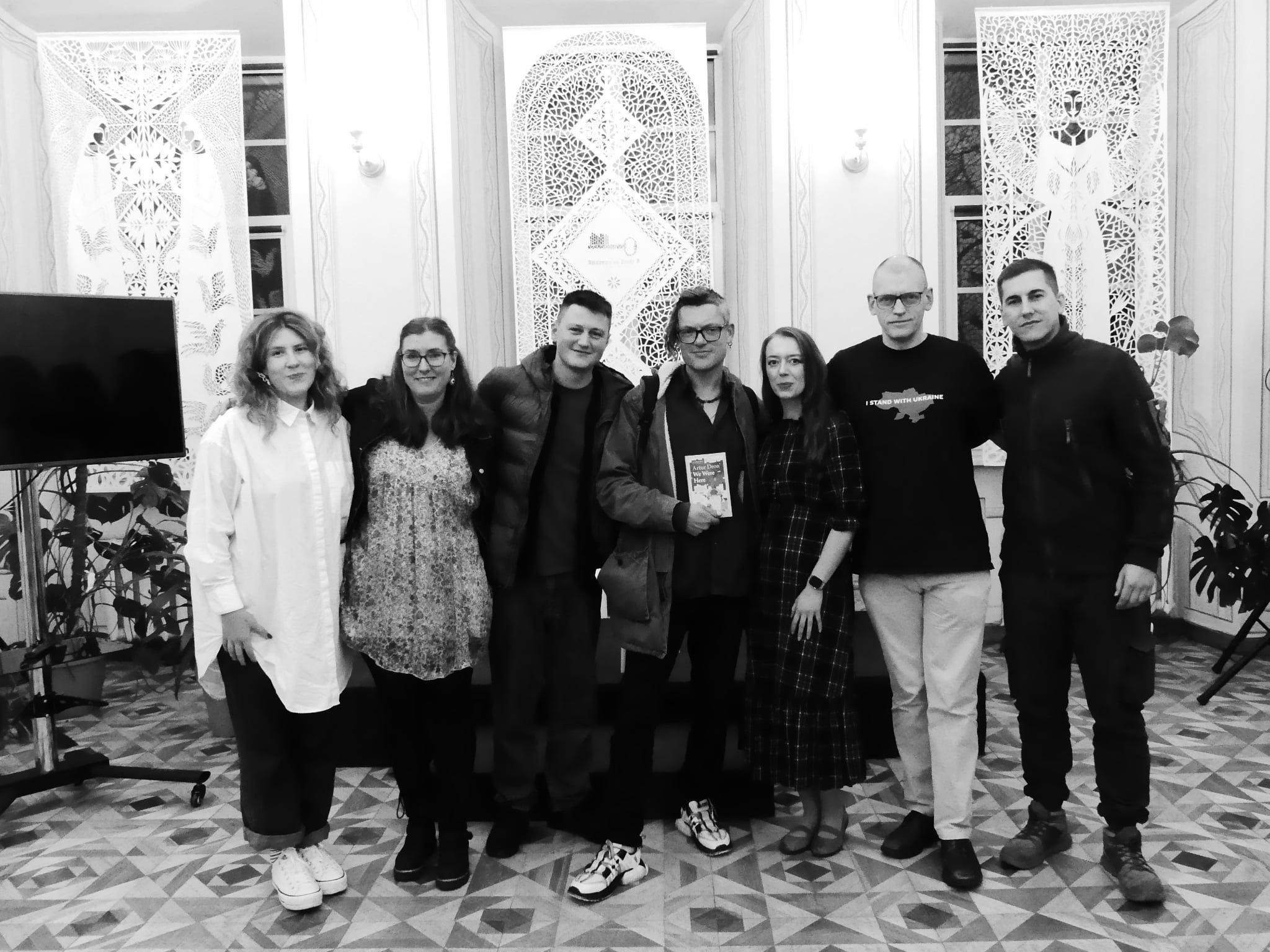
L to R: Hanna Khriakova, Fiona Benson, Artur Dron, Ihor Mitrov, Yuliya Musakovska, Hugh R. Fedir Rudyi courtesy of Olivia Resenterra
Since summer 2023, University of Exeter professor Hugh Roberts has been the University’s lead of a project to facilitate translation and promotion of Ukrainian Wartime Poetry following an international collaboration between the University and Exeter City of Literature called Translating Cultures. In October 2025, Hugh visited Lviv, Ukraine for the annual BookForum.

Hugh Roberts, Fiona Benson, and Yuliya Musakovska (Lviv BookForum official photo)
Lviv (a UNESCO City of Literature since 2015) is a beautiful city whose beauty is made even more poignant by the constant menace hanging over it. I travelled there in early October 2025 for the BookForum, a huge literary festival running over several days in multiple locations. It was my first time in Ukraine, in the fourth year of Russia’s full-scale invasion that Western experts predicted would lead to the fall of Kyiv in three days…
It was also the first time in Ukraine for Fiona Benson, the wonderful poet with whom I’ve been working on editing and promoting translations of Ukrainian wartime poetry. The Guardian invited Fiona to write an article on her experience: ‘“After the reading, the poets hold each other”: what happens when Ukraine’s largest literary festival comes under Russian attack’ – Fiona put things far better than I ever could, but I can nevertheless try to add some additional lessons from Ukraine.
Some background: I was introduced to Ukrainian literature in July 2023 by the poets and PEN Ukraine representatives, Yuliya Musakovska and Olena Huseinova (Olena is also a well-known radio presenter in Ukraine, currently working alongside the famous writer and rock star, Serhiy Zhadan, for Radio Khartia in Kharkiv) and Hanna Khriakova, International Manager for Lviv City of Literature.
They were visiting Exeter as part of ‘Translating Cultures with UNESCO Cities of Literature’, an event co-organised between Exeter City of Literature and Languages, Cultures and Visual Studies at the University of Exeter.
The event was always intended as an opportunity to forge new international connections that are the lifeblood of both the UNESCO Creative Cities network and Languages & Cultures at the University of Exeter, but I hadn’t anticipated how profound the connection to Ukraine would be nor that it would lead me and others I’d travelled with to a hotel basement doubling as a bomb shelter, in the largest Russian air assault on Lviv since the full-scale invasion began.
That this bombing occurred during a major international cultural event is surely no coincidence, for Russia’s war of aggression comes with a genocidal intent to destroy Ukrainian language and identity.

Presenting Ukrainian wartime poetry translation at BookForum (Lviv BookForum official photo)
In the UK and doubtless elsewhere in western Europe, it seems we’ve all but given up the idea that culture and indeed literature are essential matters of identity and hence of security and resilience.
Ukraine teaches otherwise. Ukrainian wartime poets not only continually remind us of what really matters but they’re also practical and realistic, far more so than supposed experts and politicians. To quote the extraordinary poet and Senior Corporal in the Ukrainian Marine Corps, Yaryna Chornohuz:
in this country poets are the first to sense war
and every time people say they must be mad[from [monologue], [dasein: defence of presence]
translated by Amelia Glaser with Fiona Benson and Hugh Roberts
(London: Jantar, 2025), p. 107]
Yaryna herself began serving in 2019. Her brother-in-arms, Artur Dron’, joined up within days of the start of the full-scale invasion, several years before he reached the age of conscription. He’s now a veteran following serious injury.
They both embody personally and poetically how shared cultural experience and understanding, one committed to freedom and the strength that comes from diversity, are of the essence not only of survival but also of resilience. Artur’s masterpiece, We Were Here (London: Jantar, 2024), translated by Yuliya Musakovska, which was the first translation we brought out, is exceptional testimony to this.
In Lviv, Fiona and I witnessed an extraordinarily vibrant cultural life – it’s no exaggeration to say that bookstores are as ubiquitous to Lviv as coffee shops are to the UK (and the coffee is better in Lviv, too…)
The poets are literally rock stars, as Yuliya demonstrated on the first night of the BookForum when she performed at ‘Poetry and Music Non-Stop’ in a nightclub, while Fiona and I watched on from the mosh pit, equal parts awestruck and awkward (speaking personally for the latter).
But even witnessing such things, and enjoying them, it was impossible to lose sight of how vulnerable all such life is, because to be Ukrainian, indeed to be in Ukraine, is to be a target of Russian aggression.
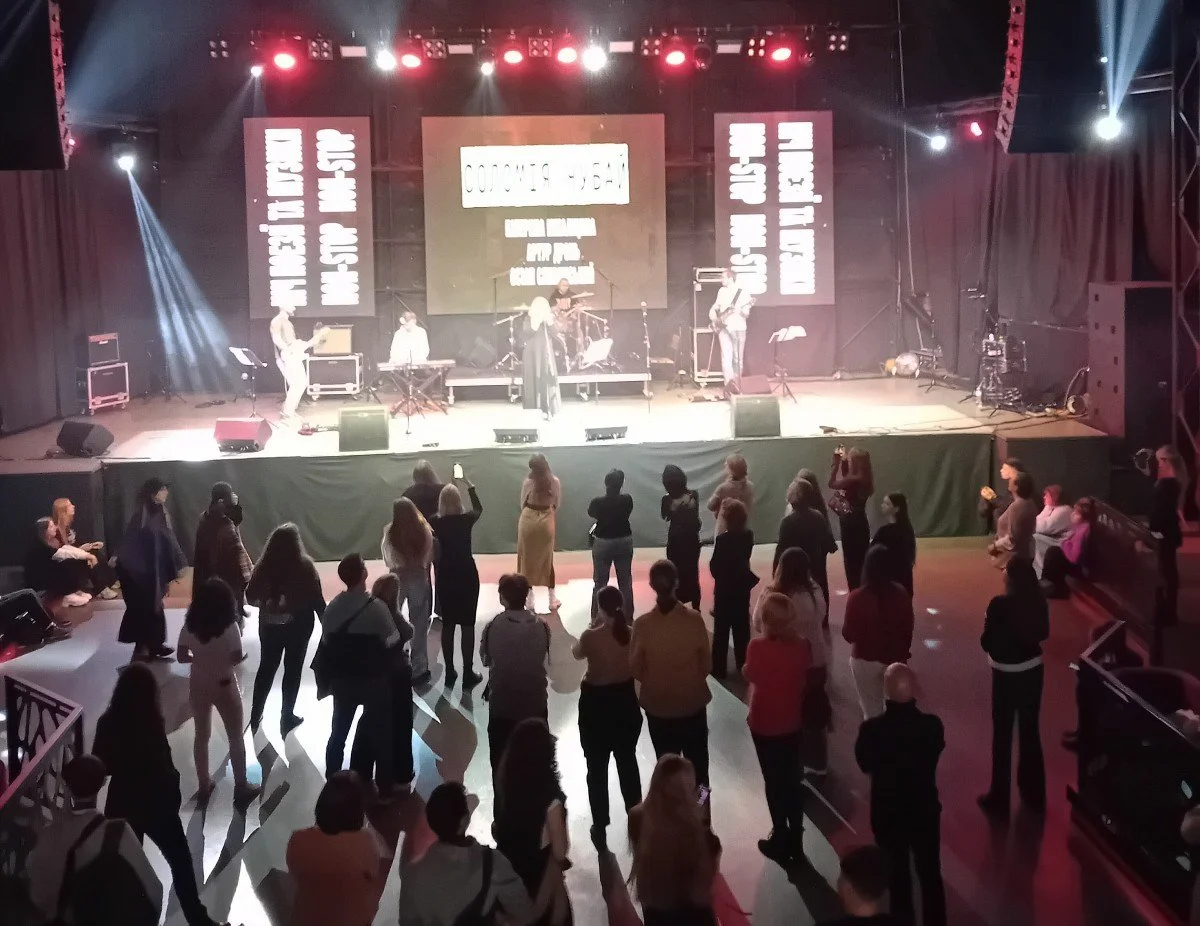
The Poetry and Music Non-Stop event
It didn’t therefore come as a complete shock when the eerily quiet and calm announcement of reports of drones approaching Lviv came over the hotel PA. We proceeded to spend several hours in the hotel basement/shelter.
Our friends and colleagues, Hanna of Lviv City of Literature and Yuliya too, kindly kept us informed of how serious the attack was, with numerous drones and several hypersonic missiles launched against a city and region that poses no military threat.
It was at once unreal yet all too real: a family, including a fifteen-year-old girl, was killed in the Lviv region.
The sole survivor was the father, who was defending them on the front line, and who had been reassuring his daughter the evening before that he was as fine as he could be.
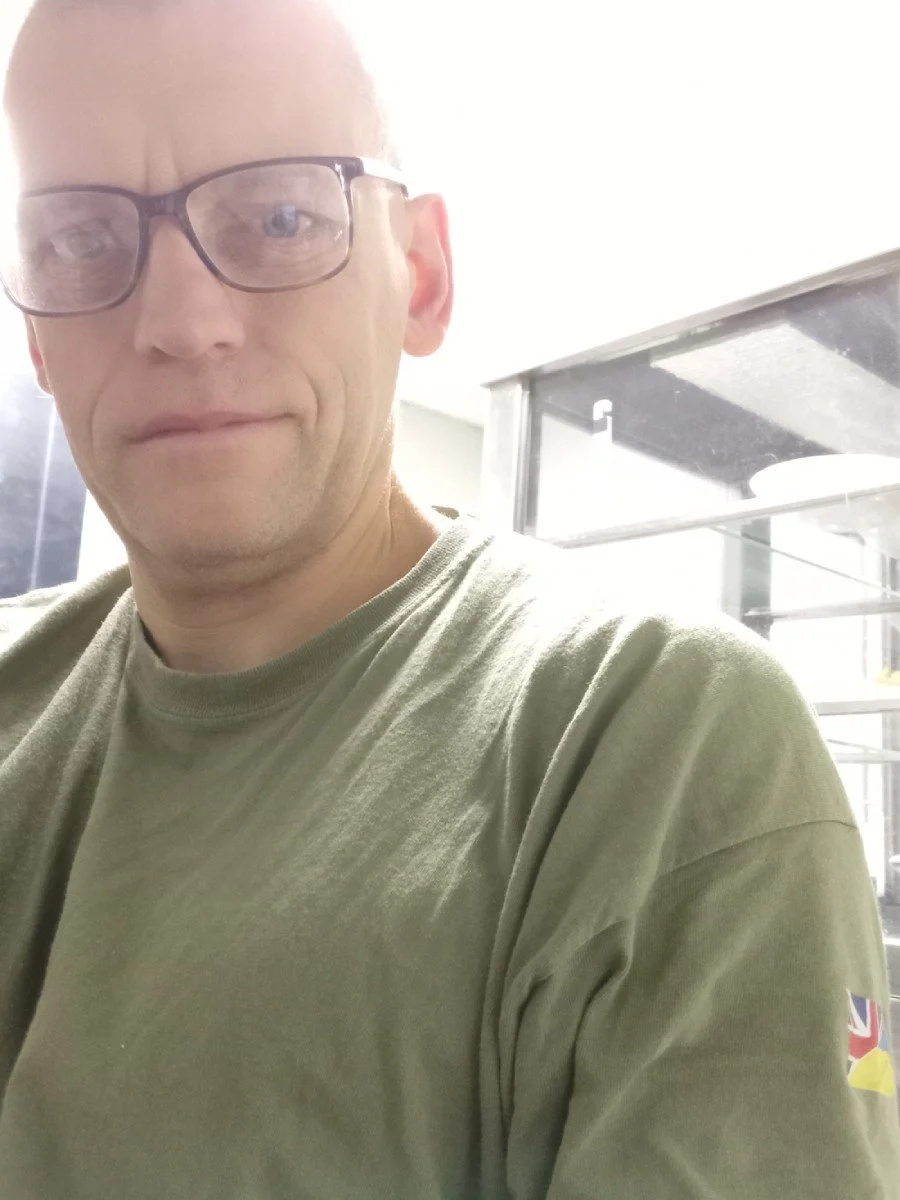
Hugh in the hotel’s bomb shelter in Lviv.
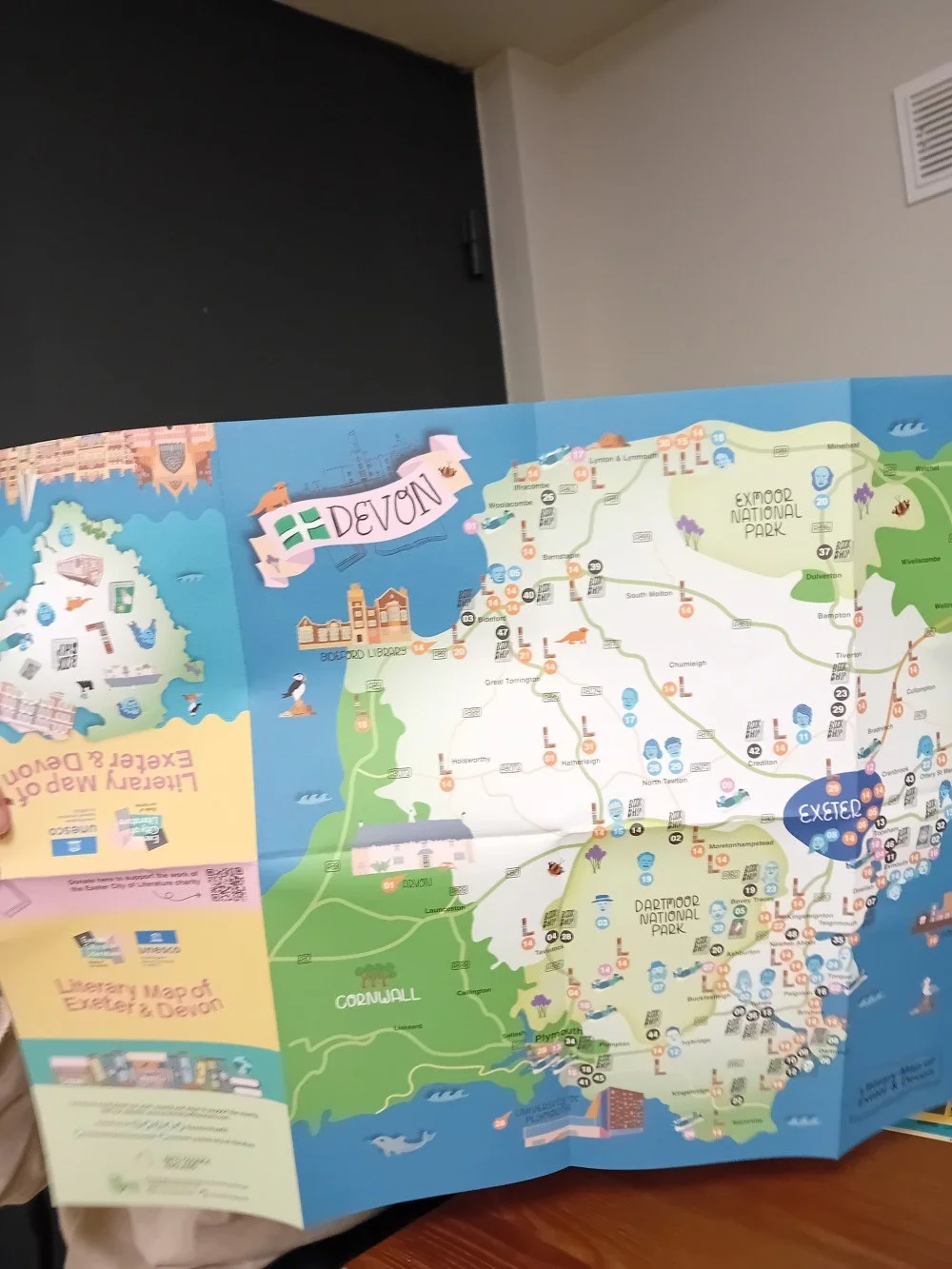
Hotel guests browse the Literary Map of Exeter and Devon in the shelter.
Back in summer 2023, thanks to Yuliya, Olena, and Hanna, I learned two vital lessons that I devoutly wish more people would realize.
First, Ukraine is a nation that has maintained its language and culture despite centuries of Russian imperial attempts to erase them, which are ongoing, seen in the killing of over 250 Ukrainian creatives.
It would be a heinous crime against all humanity if Russia were ultimately successful. Second, the work they shared – especially that of poets serving on the front lines – including Artur Dron’, Maksym Kryvtsov, and Liza Zharikova – is of pre-eminent importance.
We were, I believe, the first to share Maksym Kryvtsov’s masterpiece, ‘“Mary” to “Golgotha”’, in English; I’m personally grateful Yuliya was able to share a recording of that reading with him before he was killed by a Russian shell in January 2024, mere days after the publication of his first and last book. To state the obvious, work on Ukrainian wartime poetry is existentially urgent.

Poet soldiers Fedir Rudyi, Ihor Mitrov and Artur Dron on stage at BookForum in Lviv
Writing in London in 1943 not long before her short life came to an end, the philosopher Simone Weil wrote that the need for roots is perhaps the greatest and yet the least recognised need of the human soul. Ukraine and Ukrainian poets especially teach us that knowing those deep roots, and drawing on them for the energy to fight back against tyranny, are exactly what’s needed. Paying attention to cultural lessons from Ukraine is a matter of existential urgency.